
THE STORY BEHIND THE LABEL
Dickies: from Texas workwear to streetwear
How Dickies grew from a Fort Worth bib-overall business, why the 874 crossed into skate culture, and what we look for in preloved workwear.
Fort Worth, 1922: a business built around bib overalls
Dickies traces its beginning to Fort Worth, Texas, in 1922. The brand’s European history names E.E. “Colonel” Dickie, his cousin C.N. Williamson and Williamson’s son C. Don Williamson as the Texans who established the US Overall Company. That business became the Williamson-Dickie Manufacturing Company and initially concentrated on bib overalls.
The origin matters because Dickies did not start as a fashion label borrowing the appearance of work clothing. Its identity grew from making garments for workers, with function, hard wear and straightforward shapes at the centre. The current US history describes the early company as a small Texas operation whose bib overalls were built around quality and practicality.
These are company-published accounts of its own past. They establish the documented founders and place of origin; they do not tell us the exact age of an individual preloved garment.
Uniforms, international growth and the 874
Dickies’ official histories record several major developments. During the Second World War, the company switched from ordinary consumer production to military uniforms. Its Australian timeline says the US government commissioned nine million uniforms, after which Dickies returned to civilian workwear.
In the 1950s, the company expanded beyond the United States. Dickies’ European history says Texan oilfield workers helped introduce the clothing to the Middle East before the brand moved further into European markets. That is the brand’s own account of how practical Texas workwear travelled internationally.
The best-known product milestone came in 1967 with the launch of the Original 874 twill work trousers. Dickies describes the original as a high-rise, relaxed, straight-leg design in rigid non-stretch twill. Its Australian archive identifies a 65% polyester and 35% cotton blend and says the 874 quickly became a bestseller. Those details describe the original model, not every later pair carrying the Dickies name.
Why workers’ trousers found a second life in skate culture
By the late 1970s and 1980s, Dickies says customers were wearing its clothing as fashion as well as workwear. The company responded with new colours and styles. Its Australian timeline then places another turning point in the 1990s, when the garments’ ability to cope with scrapes attracted skaters and helped Dickies become part of West Coast culture.
The current Dickies skate collection makes the same connection in practical terms: firm fabrics, relaxed cuts and robust construction can suit movement and repeated use. It also calls the 874 a style that skaters have worn for decades. This is first-party evidence of the cultural role Dickies chooses to emphasise, rather than an independent measure of popularity.
Our editorial view is that the crossover lasted because the clothes still look like workwear. A straight leg, plain colour and small woven badge are easy to combine, while looser proportions can produce a recognisable skate-influenced silhouette without relying on large graphics.
Why we stock preloved Dickies
Dickies works well in our Gloucester shop because its trousers and jeans can fill several practical wardrobe roles. Our catalogue includes Original Fit 874 styles, a Flex version, carpenter trousers, slim or skinny work trousers and straight-leg workwear jeans. That variety lets shoppers choose between traditional roomy shapes and more fitted alternatives.
A navy or charcoal 874 can sit between casual and smarter outfits with a plain T-shirt, overshirt or knit. Carpenter trousers add utility-pocket detail, while faded jeans create a more relaxed look. These are our styling suggestions. A preloved Dickies garment should not be treated as protective clothing, uniform or safety equipment unless the individual listing and labels explicitly support that use.
For us, preloved value comes from the exact garment: its current price, measurements, fabric, condition and likely use. We do not claim a fixed saving against a new equivalent. A visibly worn pair can still appeal as casual workwear style, but marks, fading or missing labels must be considered honestly rather than excused by the badge.
Choose the fit and condition, not only the logo
Check whether the listed waist comes from an original label or from a laid-flat measurement. Several pairs in our catalogue have measured rather than labelled waists, and some do not have a confirmed inside leg. Compare the waist, rise, thigh and inside leg with trousers you already wear comfortably, then ask for a missing measurement before ordering.
Read the fabric information for the individual pair. An Original 874 may use rigid twill, while a Flex or slim style can contain stretch fibres and feel very different. Inspect the actual-item photographs around the waistband, seat, knees, pockets and hems, and pay attention to disclosed marks or fading on workwear that has already seen use.
The live shopping section below only displays Dickies pieces that pass the current availability and photograph checks. Browse the Dickies collection or the full shop for today’s options; one-off sizes and colours can sell between visits. UK delivery is available, with free Gloucester collection by appointment.
Explore preloved Dickies
One-off clothing, actual-item photographs and individual condition details. Check each listing for current availability.
Shop preloved Dickies ↗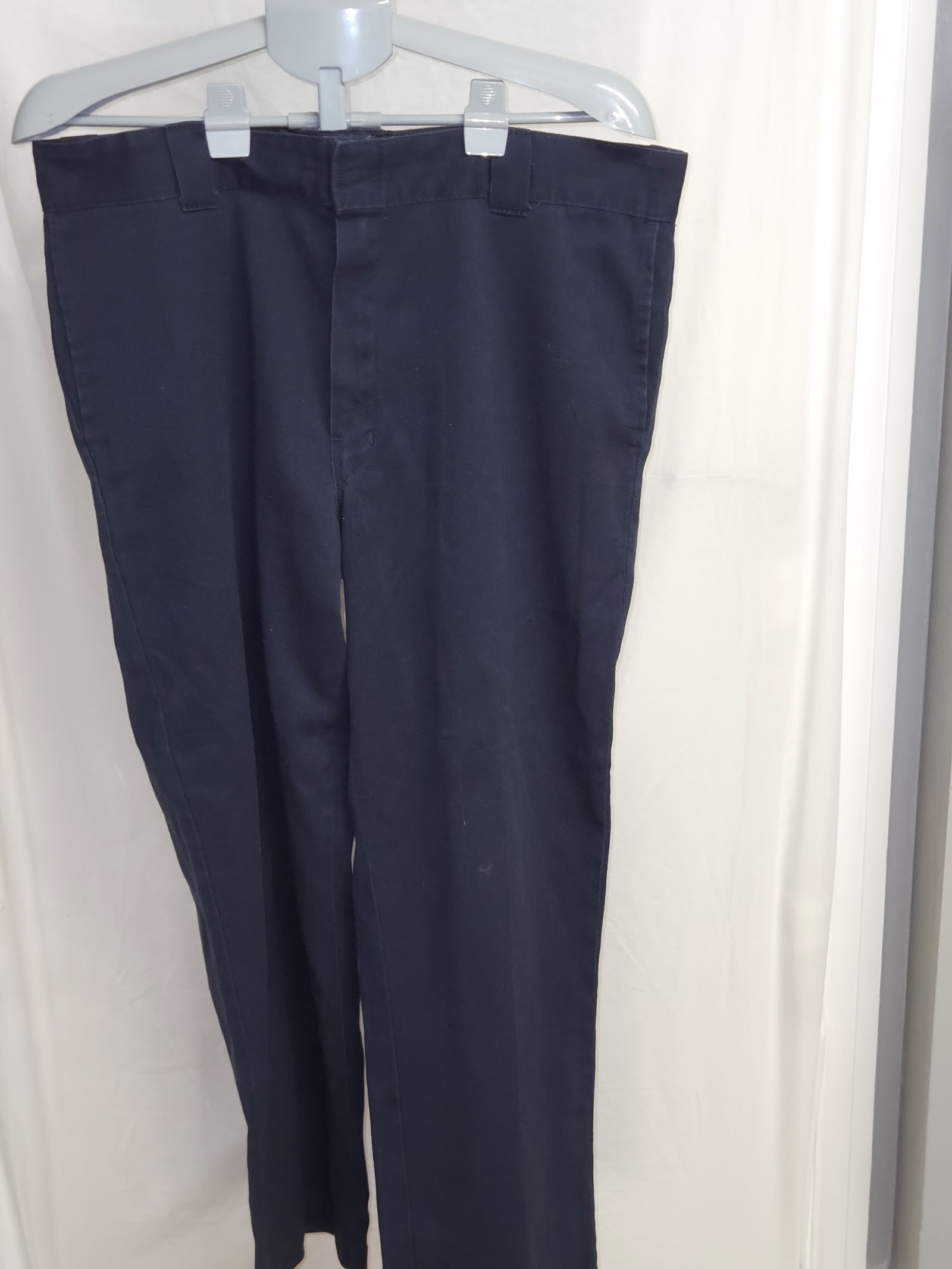 874 Flex Navy Original Fit Work Trousers
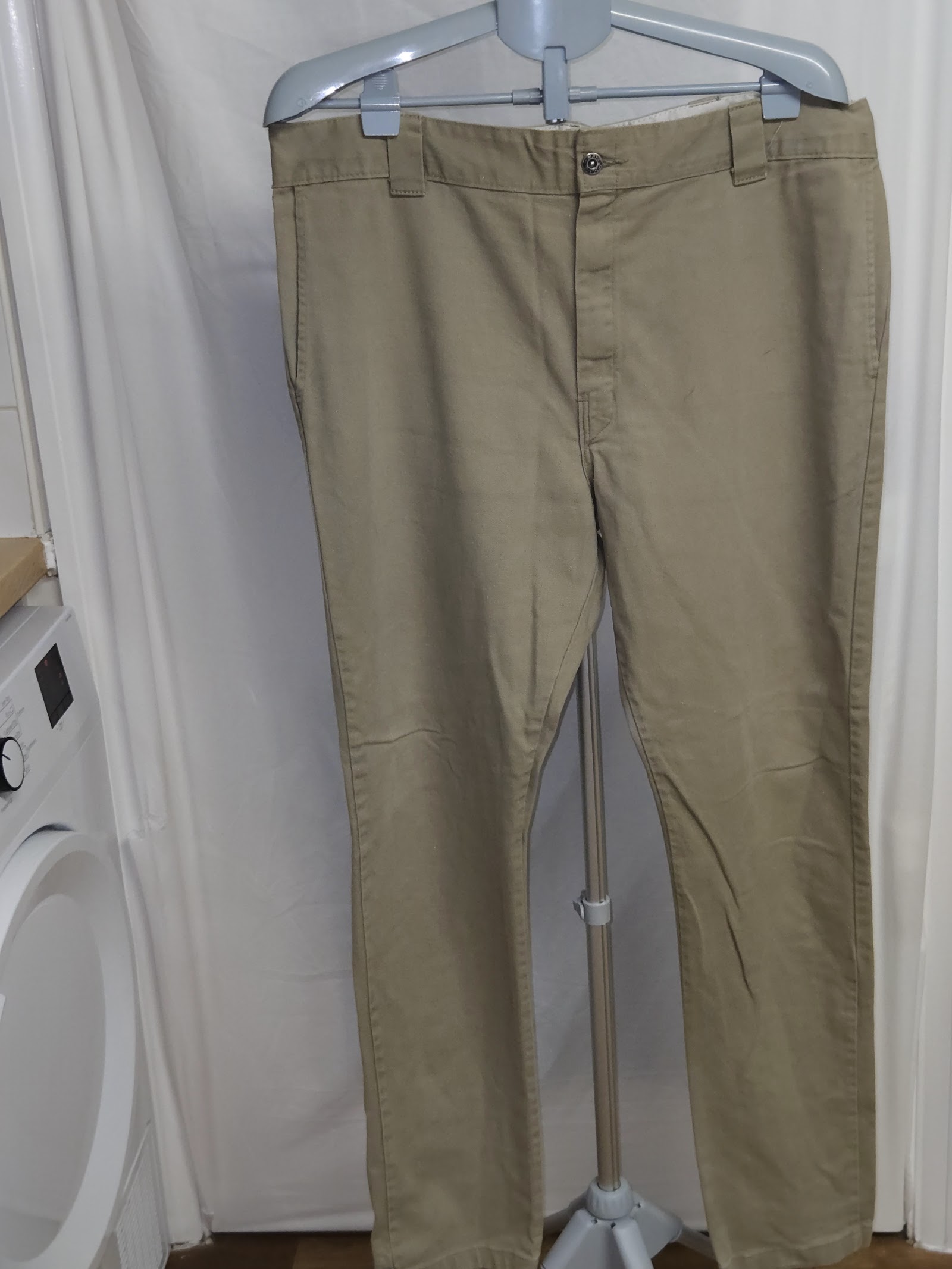 Slim Skinny Beige Work Trousers
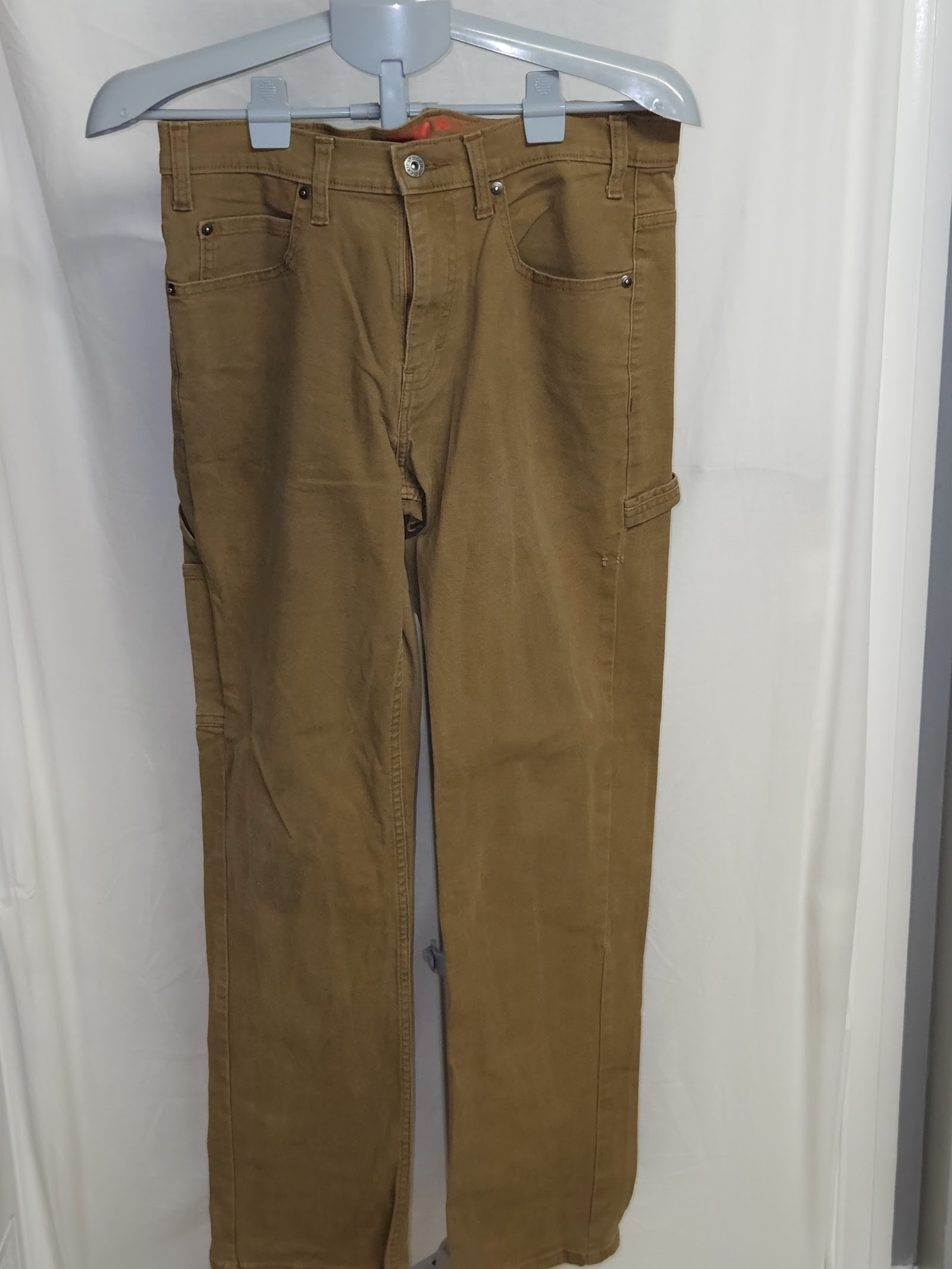 Brown Flexible Carpenter Work Trousers
History sources
Historical details checked against the sources linked below. Our styling views and stocking reasons are our own.
- Dickies US — official heritage page: bib overalls, international reach and core icons
- Dickies Europe — official history naming the 1922 founders and early company
- Dickies Australia — official timeline: wartime production, the 874 and 1990s culture
- Dickies US — official 874 family guide: its 1967 launch, fit and fabric
- Dickies US — official account of workwear’s adoption in skate culture