

THE STORY BEHIND THE LABEL
G-Star RAW: Amsterdam origins and a different shape of denim
From Jos van Tilburg’s 1989 beginnings to the sculpted Elwood jean: the G-Star RAW story, its cultural appeal and our practical guide to buying it preloved.
Amsterdam, 1989: the beginning of G-Star
G-Star traces its origins to Amsterdam in 1989. Jos van Tilburg’s official biography identifies him as a co-founder and says he began the business under the name Gap-Star that year. It explains that he later changed the name to G-Star as international expansion brought the earlier name into conflict with existing trademark rights.
Denim was the central idea, rather than a later addition to a general clothing label. The company’s own history emphasises untreated denim, experiments with fabric and construction, and clothing shaped around the body. That is the useful starting point for understanding G-Star RAW: a familiar wardrobe material approached as something that could be redesigned.
1996: jeans that were shaped, not simply cut flat
The Elwood arrived in 1996. In G-Star’s account, designer Pierre Morisset took inspiration from weathered motorcycle trousers whose shape had changed through wear. He used seams and inserted panels to build a denim silhouette around the body rather than relying on a conventional flat construction.
Angled pockets and diagonal thigh seams made that approach visible. The official archive records later developments including a cotton-and-nettle version in 2010 and a 2023 relaunch offering regular and loose fits. The Elwood was therefore an evolving design, not just a single pair frozen in the 1990s.
That history is worth keeping separate from individual stock. Our catalogue records 5622 3D Tapered pinstripe jeans; this article does not identify that pair as a 1996 Elwood, date its manufacture or claim that every G-Star design has the same construction. Always use the actual model description and photographed labels.
Why the label became culturally recognisable
G-Star’s Elwood history names Pharrell Williams, Justin Bieber and Jaden Smith among its wearers. Its wider company story also records collaborations with photographer Anton Corbijn, musician Burna Boy and chess player Magnus Carlsen. Those documented links show visibility across music, image-making and less expected cultural settings; they are not independent popularity rankings.
Our editorial view is that the clothing has an identity even without the famous names. A shaped leg, conspicuous seam or purposeful zip can make a quiet black or charcoal outfit more interesting. The attraction is in the details and silhouette as much as the branding.
This is why the history matters to a second-hand shopper: it gives context for unusual design choices. It does not make a garment rare, collectible or more valuable automatically, and celebrity connections are not a substitute for checking whether the actual piece suits you.
Why we stock preloved G-Star RAW
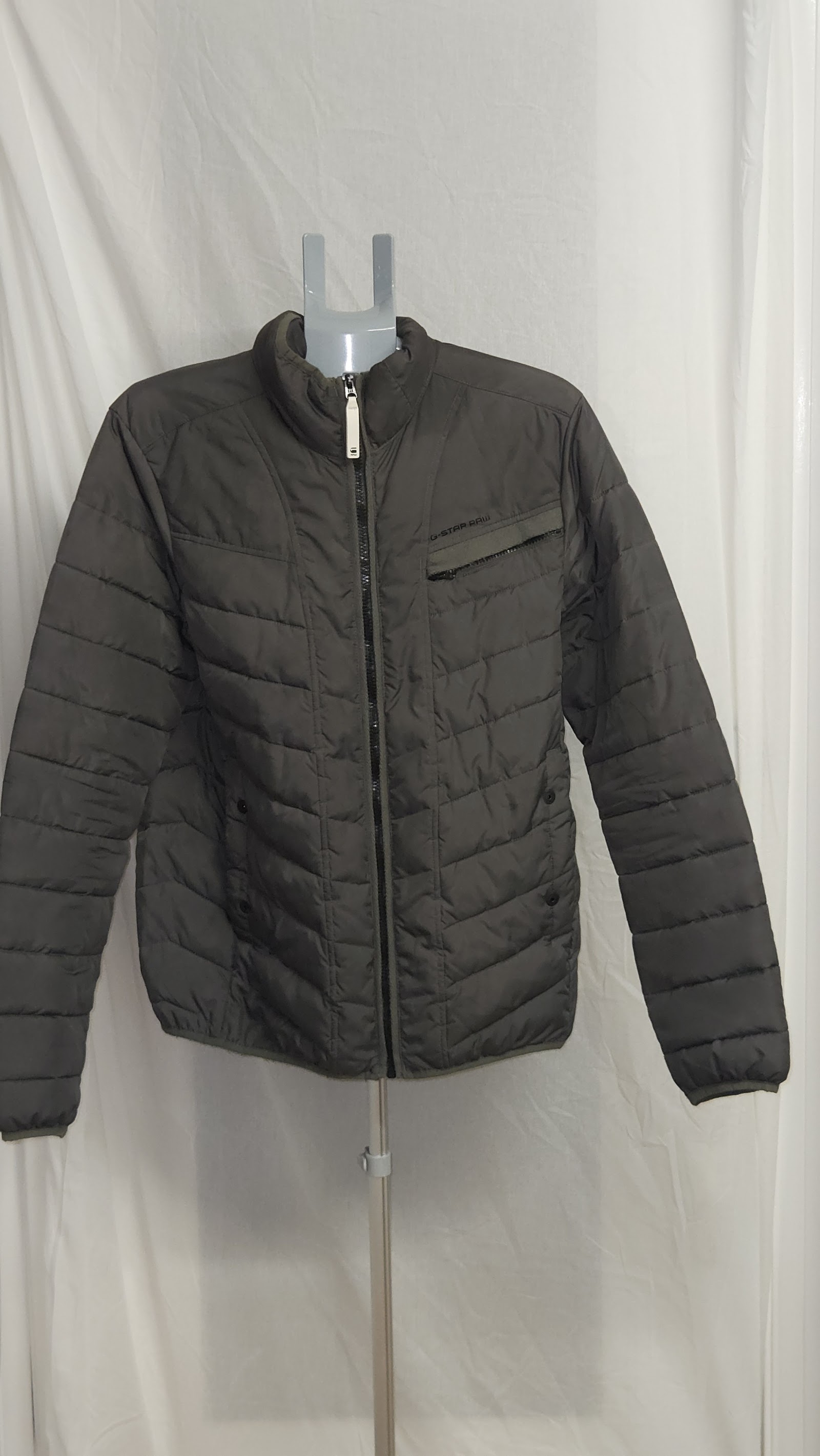
The G-Star pieces recorded in our catalogue include black-and-white 5622 3D Tapered pinstripe jeans, a black zip-detail jacket and a charcoal quilted zip jacket. They offer different wardrobe roles: a patterned focal point, a sharper casual outer layer and a textured alternative to a plain jacket. The live product cards below determine which photographed items are currently available.
We would keep the rest of an outfit simple around pinstripe jeans: a plain T-shirt or knit lets the pattern and cut do the work. A black zip-detail jacket can sit over a neutral top, while charcoal quilting adds texture without introducing a strong colour. These are our styling suggestions, not claims about the garments’ original campaigns or intended technical use.
For us, preloved value means finding a piece whose fit, condition and price make sense for how often you will wear it. The label is a reason to look more closely, not a reason to ignore wear or pay for features you do not need. We do not assume a fixed saving against a new equivalent.
A useful fit-and-condition checklist
With shaped or tapered jeans, waist size is only the beginning. Compare the rise, thigh width, inside leg and hem opening with trousers you already enjoy wearing. A labelled W38 L32 is a label reading, not a fresh measurement of a used garment; ask for any measurement that would decide the purchase.
Inspect the seat, crotch, hems, pocket edges and seams in the actual-item photographs. Look at the complete pair rather than deciding from the back patch alone. The RAW name should not be used as proof that a particular second-hand pair is unwashed, untreated or made from a specific fibre blend.
For jackets, compare chest width, sleeve length and body length, allowing room for your usual layers. Check zip teeth, pulls, cuffs and lining where shown. A biker-style appearance does not establish protective motorcycle specification, and quilting alone does not prove a particular insulation level.
Read each listing’s material and condition notes. Where the fibre composition is unconfirmed, we leave it unconfirmed rather than guessing. Use the G-Star RAW topic link to browse the collection or the full-shop link below to explore other clothing. Photographed product cards appear only when matching garments pass the current availability checks.
Explore preloved G-Star RAW
One-off clothing, actual-item photographs and individual condition details. Check each listing for current availability.
Shop preloved G-Star RAW ↗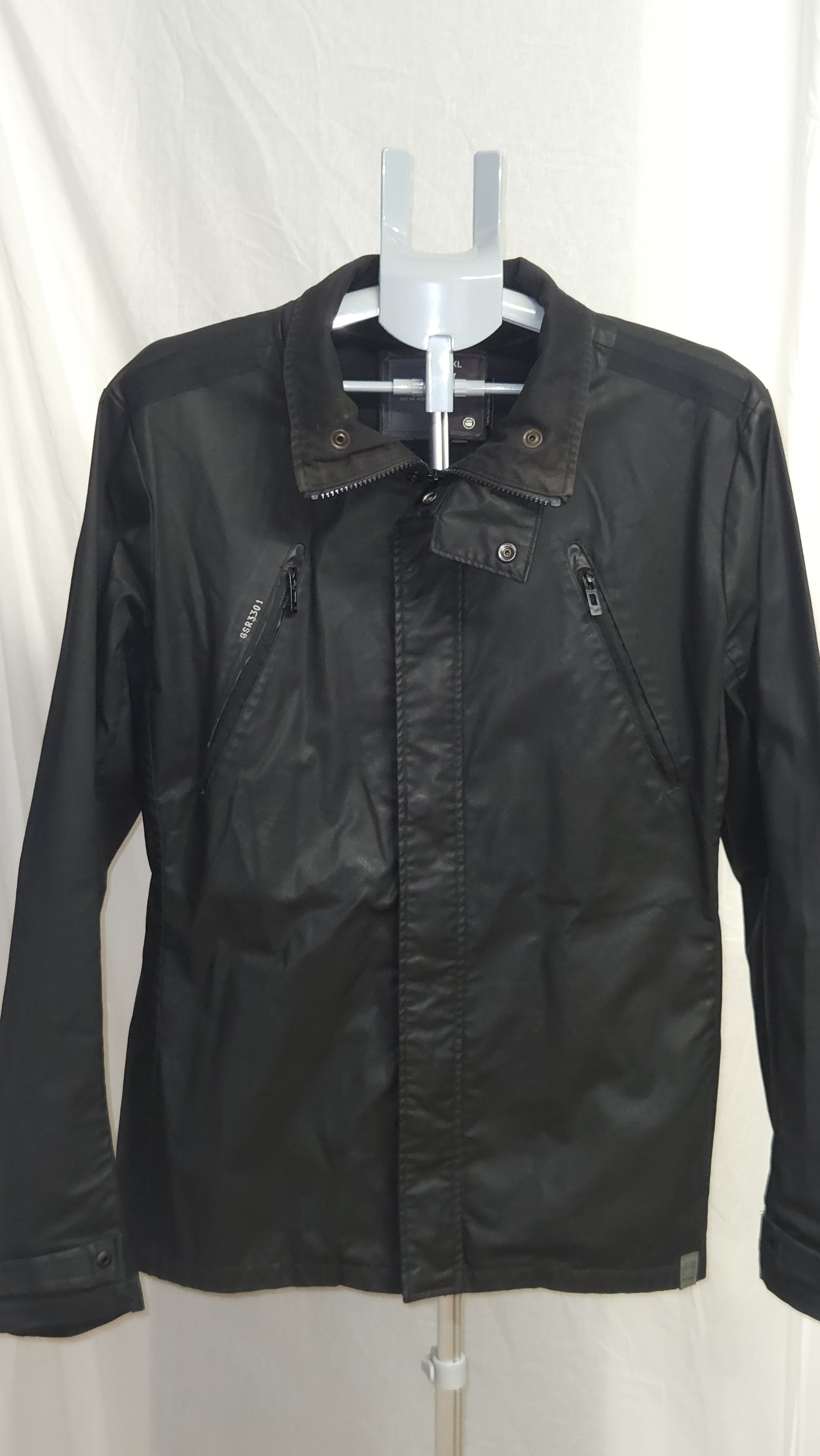 Black Zip-Detail Jacket
 Charcoal Quilted Zip Jacket
History sources
Historical details checked against the sources linked below. Our styling views and stocking reasons are our own.
- G-Star — Our Story: Amsterdam origins in 1989, denim approach and cultural collaborations
- Jos van Tilburg — official biography: co-founder, Gap-Star beginnings and the change of name (Dutch)
- G-Star — A Brief History of the G-Star Elwood, 11 April 2025: Pierre Morisset, 1996 launch, later fits and cultural connections