
THE STORY BEHIND THE LABEL

Puma: from German sports shoes to track jackets and streetwear
How Rudolf Dassler founded Puma in 1948, why its sportswear crossed into popular culture, and what we look for in its preloved hoodies and jackets.
Herzogenaurach, 1948: Rudolf Dassler starts again
Puma was founded by Rudolf Dassler in 1948 in Herzogenaurach, Germany. He already knew the sports-shoe business: he and his brother Adolf had run the Dassler Brothers Shoe Factory, entered into the commercial register in 1924. Puma’s official timeline records their separation in 1948 and Rudolf’s move into another family building with 15 employees.
The new business initially used the name RUDA. The timeline distinguishes its January 1948 business registration from the registration of the Puma brand on 1 October that year. These were the beginnings of a footwear company, not a hoodie or streetwear label.
Another important step came in 1958, when Puma patented the Formstrip. The company explains that this curved strip originally helped stabilise the foot inside a shoe; it became a recognisable design element used on clothing too.
1968: the tracksuit joins the shoes
Puma’s 2018 annual-report archive dates its first apparel line to 1968. Rudolf Dassler wanted athletes dressed in Puma from head to toe, and the T7 jacket put a seven-centimetre Formstrip along the sleeves. Footballer Günther Netzer was among the early athletes promoting the clothing.
The company’s account says the jacket found an audience on city streets as well as training grounds. That is a useful turning point in this story: a garment designed around sporting life could become an everyday layer without losing its visual identity.
A striped Puma track jacket is not automatically a T7, however. Nor does a retro-looking colour combination establish a manufacturing date. We use the individual listing and readable labels to describe our stock, rather than borrowing a historic model name without evidence.
From sporting achievement to music and fashion
The sporting connections remained prominent. Puma’s archive records the custom-made spike worn by Usain Bolt when he ran the 100 metres in 9.58 seconds in Berlin in 2009. Such documented moments help explain why the logo is familiar far beyond specialist sports shops.
The brand’s 75th-anniversary account, published in February 2023, also describes the Suede shoe’s adoption by break-dancers and hip-hop artists in the 1980s. It highlights later collaborations with Rihanna, Jil Sander and Alexander McQueen. These are concrete links between sport, music and fashion, rather than a claim that every Puma garment has the same cultural significance.
Our editorial view is that the everyday appeal comes from recognisable shapes and details: a full zip, contrasting sleeve panels, a drawstring hood or a clear chest logo. They make relaxed clothing feel considered without demanding an elaborate outfit. That interpretation is our own, separate from the company history above.
Why we stock preloved Puma
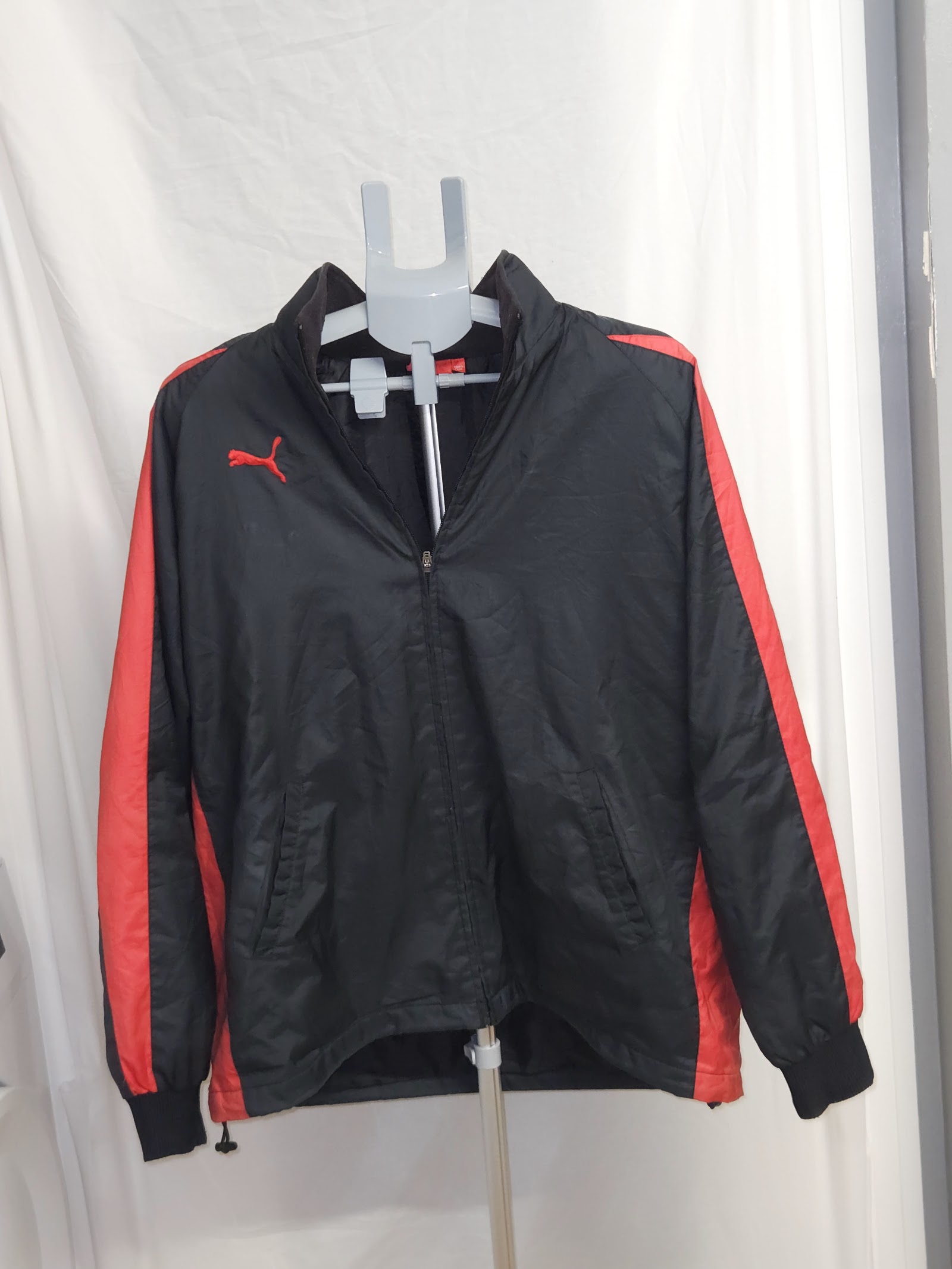
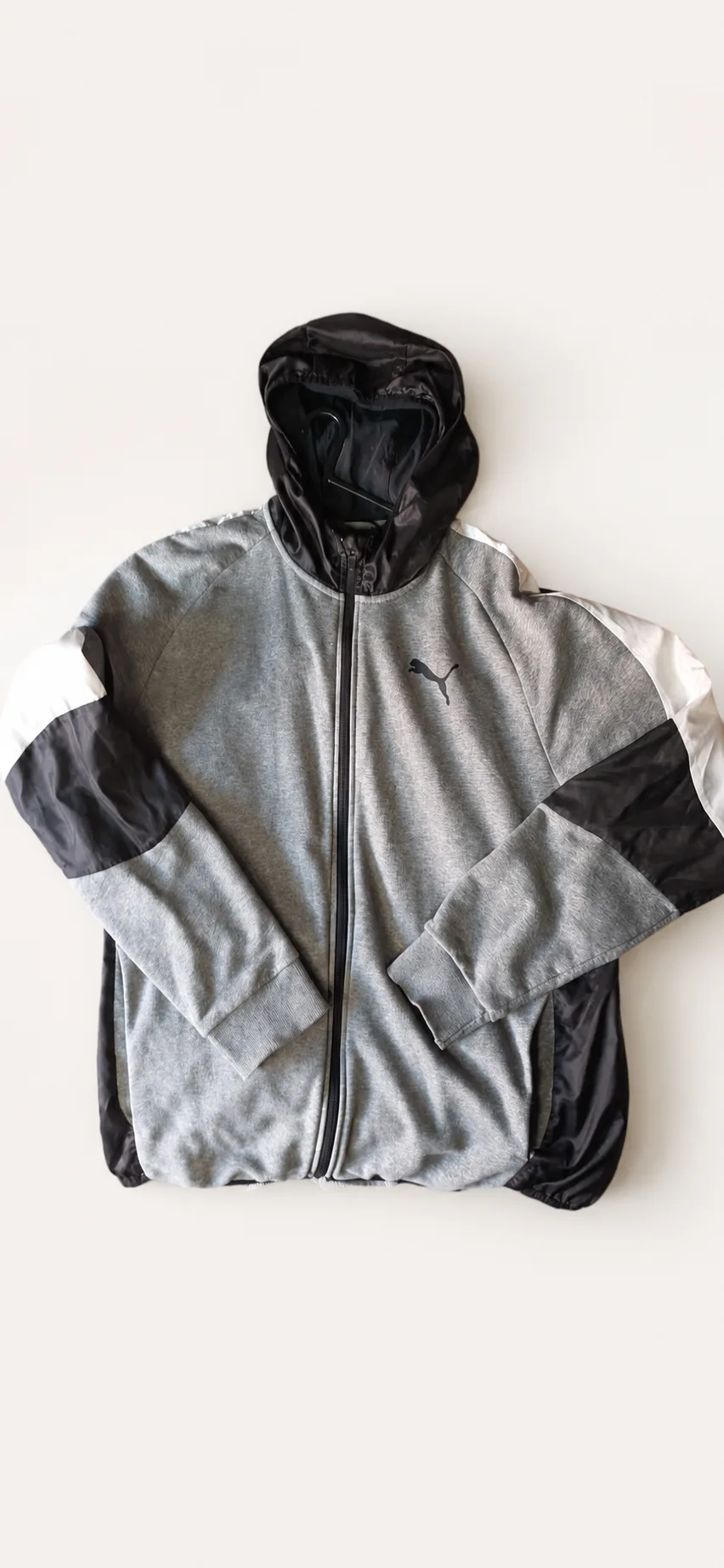
Our catalogue records a black hoodie with white branding, a black-and-red colour-block track jacket and a grey-and-black lightweight full-zip jacket. They illustrate three useful choices: a casual sweatshirt layer, a brighter sportswear statement and a quieter neutral jacket. The live shopping section below determines which individual items are currently available.
We would pair the black hoodie with straight jeans or plain joggers. Let the red panels on a track jacket provide the colour, keeping the top underneath simple. A lightweight grey-and-black jacket can be an easy layer to carry when an extra layer may be useful, provided its fit and construction suit your plans.
For us, value in preloved clothing depends on the actual piece: its price, condition, measurements and how regularly it will be worn. A familiar logo can help you find a style you like, but does not guarantee a saving or make signs of wear irrelevant.
Check the details that make a good everyday layer
Compare chest width, body length and sleeve length with a hoodie or jacket that already fits you. A size letter alone cannot tell you whether the garment leaves enough room for a T-shirt or sweatshirt underneath. Ask for missing measurements before choosing a one-off item.
For hoodies, look closely at the cuffs, hem, pocket openings, drawcords and printed or embroidered branding. For zipped jackets, inspect the zip teeth and pull, collar, lining and sleeve edges. Read the condition notes alongside all the actual-item photographs.
Do not assume that a lightweight track jacket is waterproof, or that a sporting logo proves a particular fabric technology. Where fibre composition or performance is unconfirmed, treat it as unconfirmed. Likewise, retro style is not proof of vintage age.
Use the Puma topic link to explore the brand collection, or the full-shop link below for other clothing. The product cards retain live availability checks, so the photographed selection can change as items sell.
Explore preloved Puma
One-off clothing, actual-item photographs and individual condition details. Check each listing for current availability.
Shop preloved Puma ↗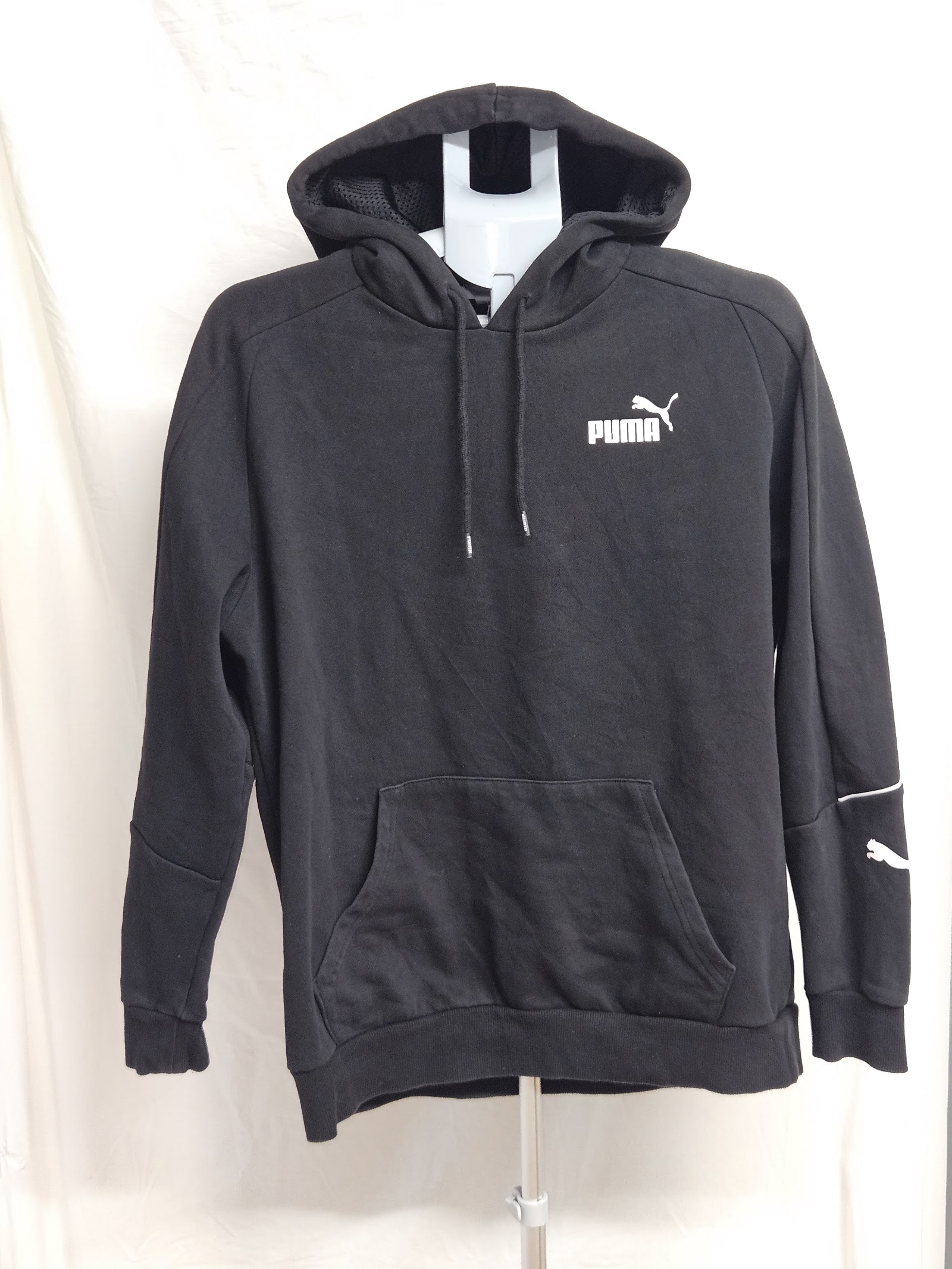 Black White Logo Hooded Sweatshirt
 Black Red Colour Block Track Jacket
 Grey and black thin full-zip jacket
History sources
Historical details checked against the sources linked below. Our styling views and stocking reasons are our own.