
THE STORY BEHIND THE LABEL
True Religion: bold stitching, denim and music culture
How True Religion grew from the Los Angeles denim scene, why its horseshoe pockets became so recognisable, and what we look for in a preloved pair.
Founded in California in 2002
True Religion’s official FAQ says Jeff Lubell and Kym Gold founded the brand in California in 2002. Its company history places the beginning on the Los Angeles denim scene, while the company’s 2012 filing with the US Securities and Exchange Commission says True Religion Brand Jeans started near the end of that year.
The early idea was not to make another quiet five-pocket jean. The brand says it reworked conventional sewing machinery to produce unusually bold stitching. That technical and visual choice gave the new label something people could identify from across a room: contrast thread, prominent back pockets and a deliberately noticeable finish.
How the stitching became the signature
True Religion describes a five-needle, two-stitch-per-inch process behind its Super T look. Its current signature-stitch guide adds a useful timeline: Big T arrived in 2004 using three ends of thread, followed by the heavier five-thread Super T in 2005. The horseshoe pocket motif and oversized flap pockets made the rear view of the jeans as important as the front.
These names refer to particular constructions rather than every garment the company has made. A preloved pair may use a subtler single-needle stitch, Big T, Super T or another detail. The model and photographed labels matter more than assuming all True Religion jeans are identical.
The company also developed recognisable fits and styles. Historic filings mention patents for the Joey style and QT stitch, while the wider range expanded beyond jeans into T-shirts, hoodies, sweats and other sportswear.
Evidence of popularity beyond the denim shop
A 2012 company filing reported that, ten years after launch, True Religion merchandise was known on six continents and annual net sales had reached $467 million. That is historical evidence of rapid commercial reach, not a claim about the brand’s sales today.
Music and celebrity visibility added another layer. In its own 2025 retrospective, True Religion records lyrical references from artists including the Black Eyed Peas, 2 Chainz, Drake and Kendrick Lamar. The same brand-published account notes later projects with Supreme in 2021, Chief Keef in 2023, and GloRilla and Duke Dennis for its 2025 ICONS collection.
Because this is the company’s own retrospective, it is best read as evidence of the cultural connections the brand chooses to highlight. Our editorial view is that the combination of bold stitching, a recognisable pocket shape and repeated appearances in music and streetwear explains why the jeans have remained easy to identify.
Why we stock preloved True Religion
True Religion works for our Gloucester shop because denim is practical, while the details give shoppers more choice than a plain pair of jeans. Dark indigo with gold thread can add contrast to a simple T-shirt and trainers; washed black can sit quietly in an everyday outfit; red, white or heavy stitching creates a more noticeable look. These are our styling suggestions, not rules.
Our catalogue records True Religion across Ricky, Rocco, Marco and Jennie Curvy styles, along with different washes and recorded conditions. A relaxed straight fit will not wear like a slim or skinny cut, even when the waist label is the same. The live shopping section below only displays matching pieces that pass the current availability and photograph checks.
Preloved value depends on the actual pair: its asking price, measurements, fabric, visible wear and how often it is likely to be worn. We do not claim a fixed saving against a new equivalent, and bold branding is not a reason to hide abrasions, fading, frayed hems or loose threads.
Choose the pair, not only the horseshoe
Start with the photographed model and size labels. Compare the waist, rise, thigh, leg opening and inside leg with jeans you already wear comfortably. Several pairs in our catalogue do not have a verified inside-leg measurement, so ask before ordering if length is important rather than relying on the waist size or fit name.
Look closely at the pocket stitching, hardware, waistband, seat, knees and hems. Some wear can suit a washed-denim look, but disclosed rips or abrasions should still be part of your decision. The brand’s own FAQ warns that a new-with-tags description alone is not proof of authenticity. Our listings document the exact garment and visible labels; they do not create an official relationship with True Religion or replace a specialist authentication service.
Use the actual-item photographs and condition notes on each product page, then check today’s price and availability. Browse the True Religion collection or the full shop for current options. UK delivery is available, with Gloucester collection by appointment.
Choose the actual pair
True Religion fit and buying guide
Choose the cut as well as the waist size. Use the photographed model label where shown, then compare that exact pair with jeans you already wear comfortably.
Ricky
The brand’s current men’s guide identifies Ricky as a straight-leg range. Check this pair’s recorded cut and measurements.
Rocco
The current men’s range uses Rocco for skinny jeans. Older or differently labelled pairs still need individual fit checks.
Billy
The current men’s guide identifies Billy as bootcut. This is a fit reference, not a promise that we have a Billy pair in stock.
Other or unidentified cuts
Use the exact listing and photographed label. Heavy stitching and flap pockets do not establish a model name.
Five checks before buying
- Read the size label and complete model wording in the photographs. W means waist and L usually means inside-leg length. W32 L32 describes the labelled size; it is not a fresh measurement or a promise that the garment now measures exactly 32 inches.
- Compare waist, front rise, inside leg, thigh and hem width with a similar pair that fits you. Use the same measuring method: a flat waistband width and a full waist circumference are different figures. A photographed tape or supplied garment measurement is more useful than a generic conversion.
- Check the care label for the fabric blend. Stretch content, washing and previous wear can affect the feel; do not assume a blend from the brand or wash.
- Inspect inner thighs, pocket corners, seat, knees, fastenings and hems. Check the notes for rips, fraying, marks, repairs or alterations, including a shortened inside leg.
- Ask for any missing detail before ordering and quote the BP stock code. Model names or photographed labels alone are not independent authentication.
Compare examples from available stock
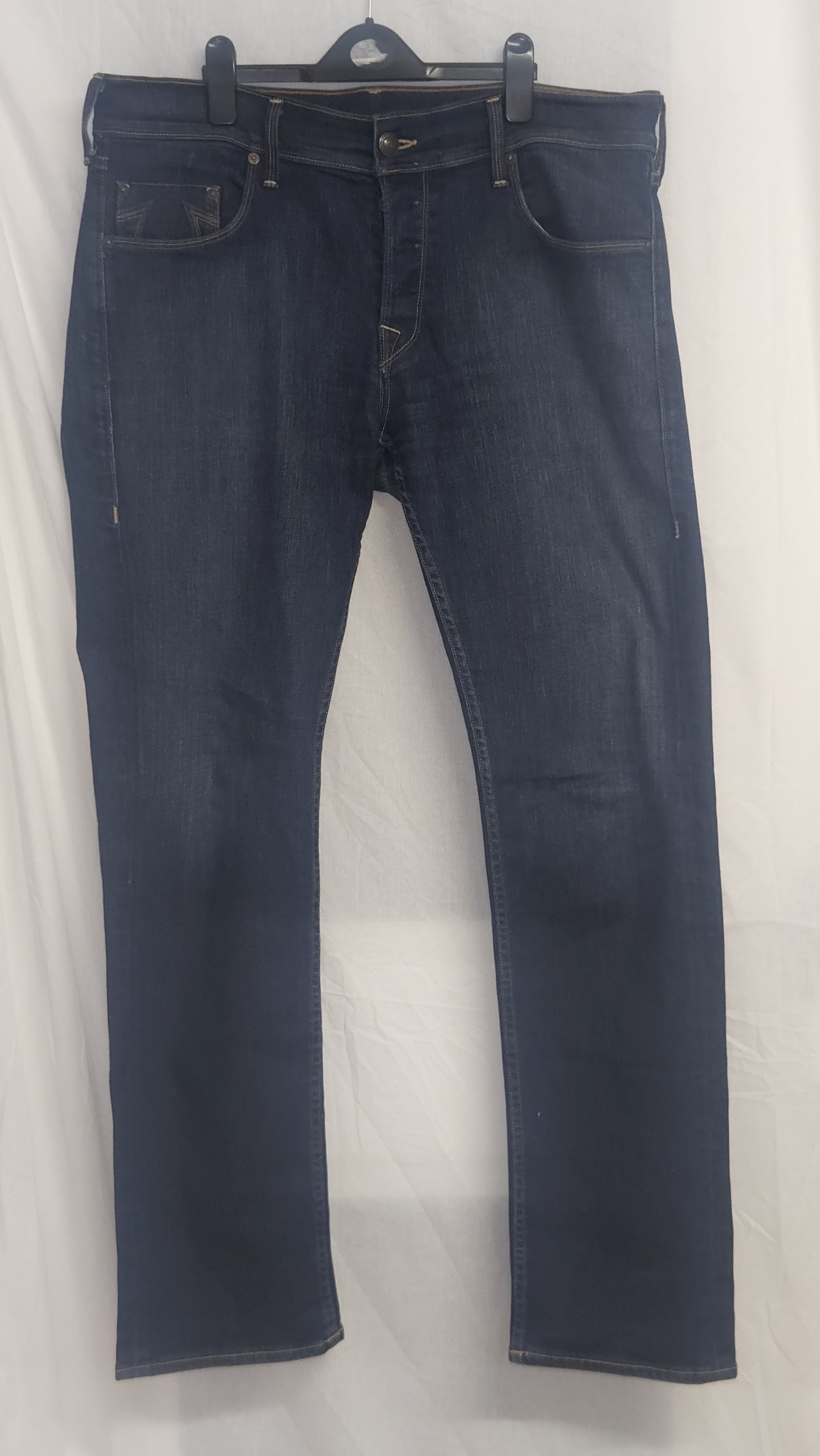 Dark Indigo Gold Stitch Button Fly Horseshoe Jeans
BP-0294 · Recorded size: W36
Condition: Pre-owned Good
Check the photographs and ask for any missing garment measurement.
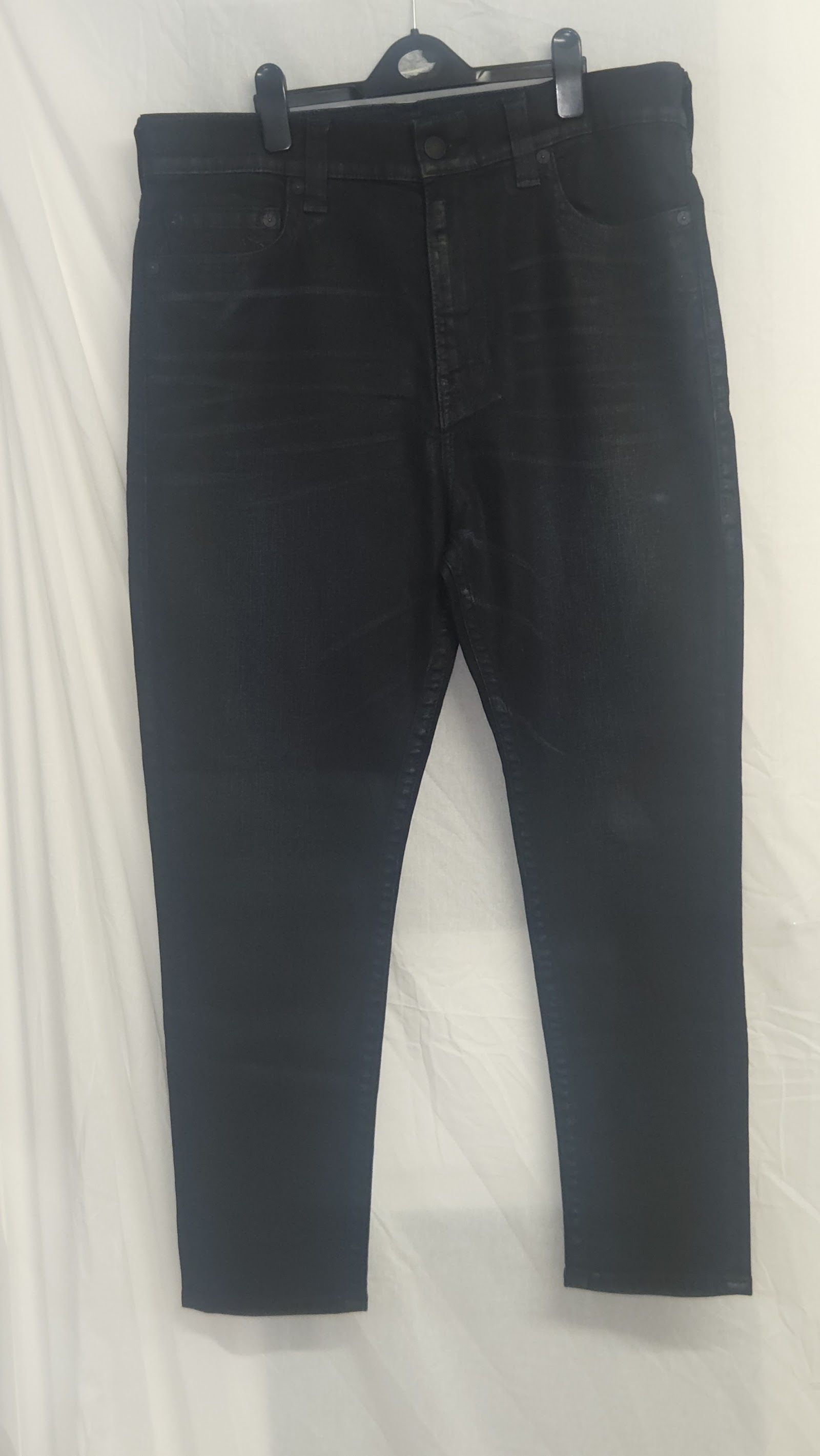 Marco Washed Black Relaxed Taper Jeans
BP-0295 · Recorded size: W33
Condition: Pre-owned Good
Check the photographs and ask for any missing garment measurement.
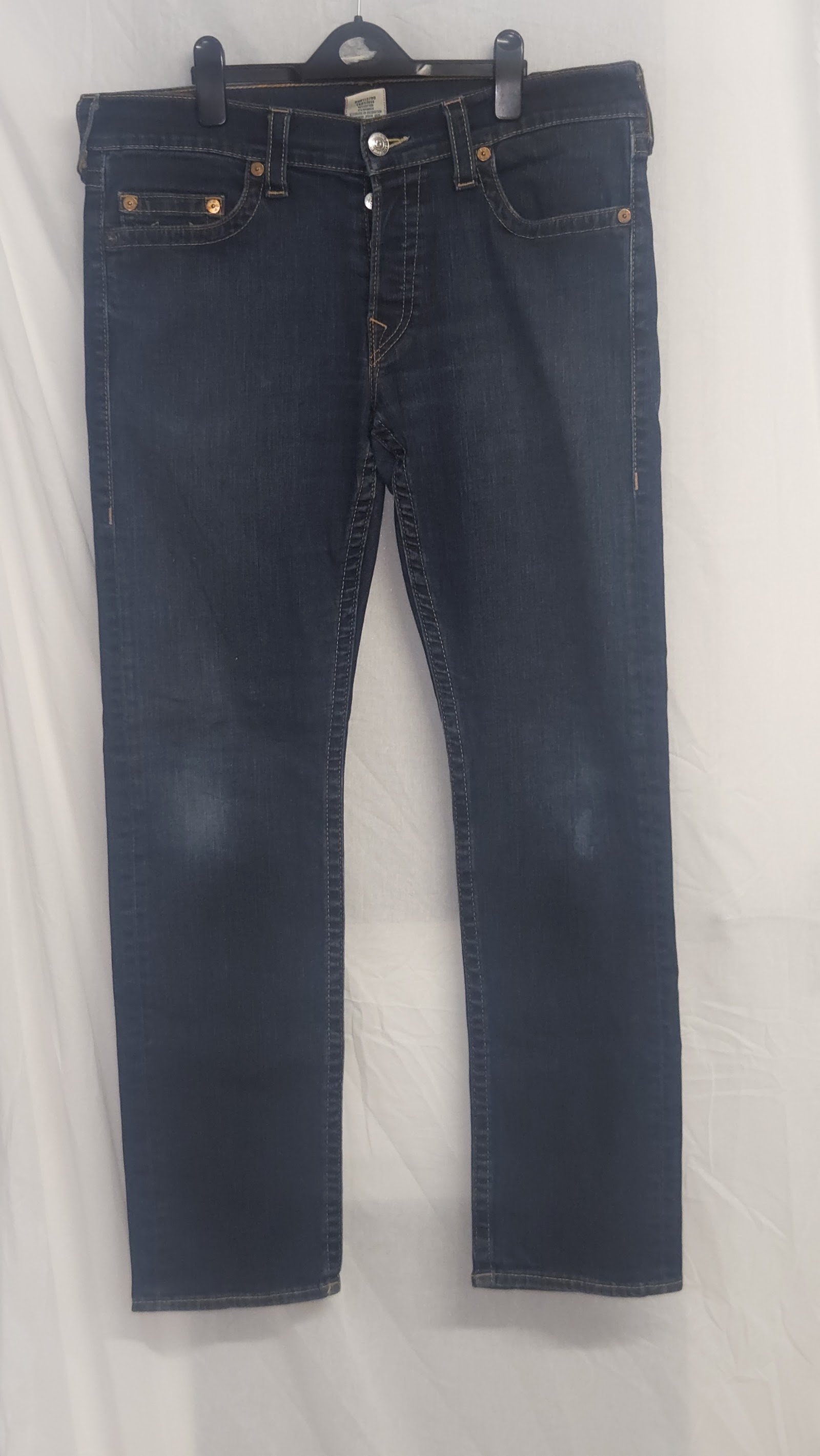 Dark Blue Gold Stitch Horseshoe Pocket Jeans
BP-0296 · Recorded size: W36
Condition: Pre-owned Good
Check the photographs and ask for any missing garment measurement.
Brand fit references
General fit descriptions checked on 9 October 2026. These are references for current brand ranges, not measurements, fabric specifications or age estimates for our individual preloved pieces.
True Religion official men’s fit guideExplore preloved True Religion
One-off clothing, actual-item photographs and individual condition details. Check each listing for current availability.
Shop preloved True Religion ↗History sources
Historical details checked against the sources linked below. Our styling views and stocking reasons are our own.
- True Religion — official company history and the five-needle Super T process
- True Religion — official FAQ: 2002 founders and guidance about labels and authenticity
- True Religion — official Big T and Super T stitch guide
- True Religion — official 2025 retrospective on music and cultural collaborations
- US Securities and Exchange Commission — True Religion Apparel 2012 annual report